

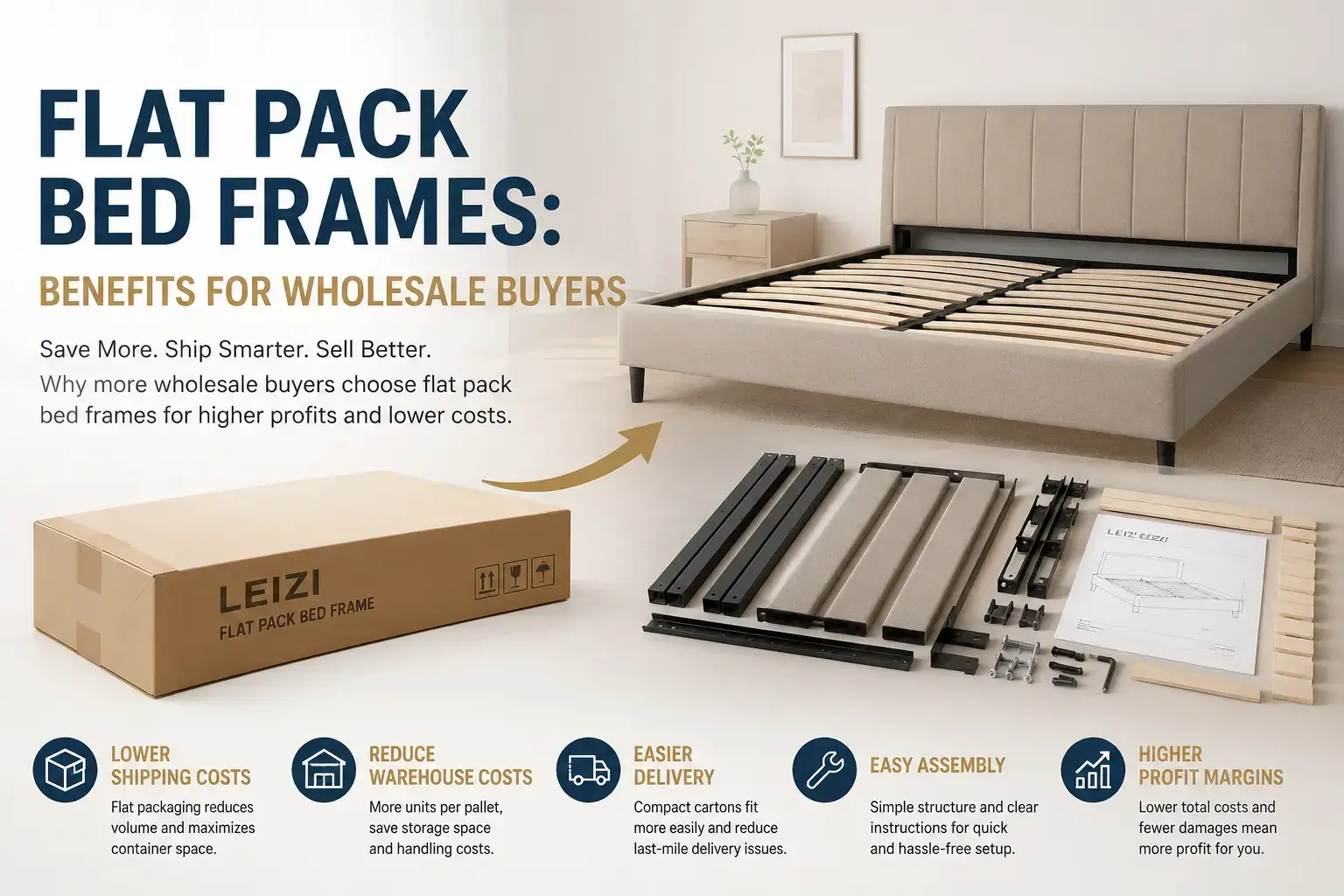
We’ve working with wholesale buyers around the world — and one shift stands out clearly: flat pack bed frames have gone from “budget alternative” to mainstream business model.
Many buyers still think flat pack is just about saving on shipping. But those who really get it? They’re quietly widening their profit margins.
In this article, we’ll share real factory insights — no fluff, no theory — just what actually works when you’re sourcing for scale.
Plain and simple: a flat pack bed frame ships disassembled, then gets put together at its final destination.
But here’s the key — it’s not just “taking apart an assembled bed.” The whole design starts with transport efficiency in mind.
At LEIZI, whether we’re doing OEM or ODM work, every flat pack structure is engineered around:
Good flat pack isn’t cheap — it’s smart.
More of our clients are choosing flat pack every year. And it’s not because they love DIY.
Container rates swing wildly. Flat pack lets you fit 30–40% more units per container.
One 40HQ might hold 120 assembled beds. With flat pack? You can easily fit 200+. That’s pure margin difference.
Flat pack takes up less space. Less rent. Less headache.
If you’re selling online, customers expect something that fits through their front door — and ships affordably.
We’ve seen clients completely pivot to e-commerce — and flat pack became their only viable option.
Too many buyers fixate on unit price. Real profit hides in logistics.
We ran the numbers for one client last year:
Added together? That boosted their net margin more than negotiating $2–3 off the unit cost.
Flat pack’s true value? Maximizing sales per cubic meter.
That’s why we obsess over packaging size during product development.
Old-school flat pack had a reputation: wobbly, weak, temporary. That’s outdated.
Today’s flat pack — especially ours — is built tough.
At LEIZI, we use:
Some of our clients sell premium-priced beds in Europe and North America — all flat pack, all rated for 300kg+.
Quality issues aren’t caused by flat pack. They’re caused by bad design.
We’ve rescued more than a few “disaster” orders. Most failures trace back to:
Unclear instructions. Too many screw types. Customers rage-quit.
Bent panels after transit. Sky-high return rates.
Cutting corners on materials = complaints after first use.
Flat pack flaws don’t stay hidden. They blow up in reviews.
When choosing a supplier, ask: Do they test every structure? Can they show drop-test reports?
Our process? Three steps — tested, proven, repeatable.
Every new design undergoes load and stability testing before tooling.
We simulate real-world shipping conditions — no surprises on arrival.
Target: under 20 minutes, minimal tools, zero frustration.
We customize versions based on your channel:
Want to see how we engineer for different markets?
👉 https://www.leizibed.com/flat-pack-bed-frames
Assembled beds still have their place — like:
But if you’re scaling globally or running lean inventory? Flat pack wins.
Our advice:
Smart buyers often run both in parallel.
A few unstoppable forces:
Flat pack isn’t just logistics — it’s the future of retail-ready furniture.
We predict: over the next 5–10 years, flat pack bed frames will keep gaining global market share.
After two decades in this business, one truth sticks:
The real gap between average and exceptional wholesale margins isn’t price — it’s design efficiency and supply chain intelligence.
Flat pack bed frames aren’t the cheap option. They’re the smart, scalable option.
At LEIZI, we focus on two things:
If you’re scaling your wholesale operation — or just tired of paying for air in your containers — flat pack deserves serious consideration.
In our view? It’s not a trend. It’s already here. And it’s not going anywhere.
—
Looking for reliable flat pack bed frame suppliers with 20 years of export experience?
Let’s talk: https://www.leizibedmattress.com/contact
Error de formato de correo electrónico
emailCannotEmpty
emailDoesExist
pwdLetterLimtTip
inconsistentPwd
pwdLetterLimtTip
inconsistentPwd